Model facts
Jev AI: specs, limits and the questions people ask
What people search about Jev AI — whether it is an LLM, what fits in its context window, what it costs, whether it runs locally — answered in a paragraph each, with the page that goes deeper linked from every answer.
Quick answer · verified 2026-09-19
What is Jev AI, in one paragraph?
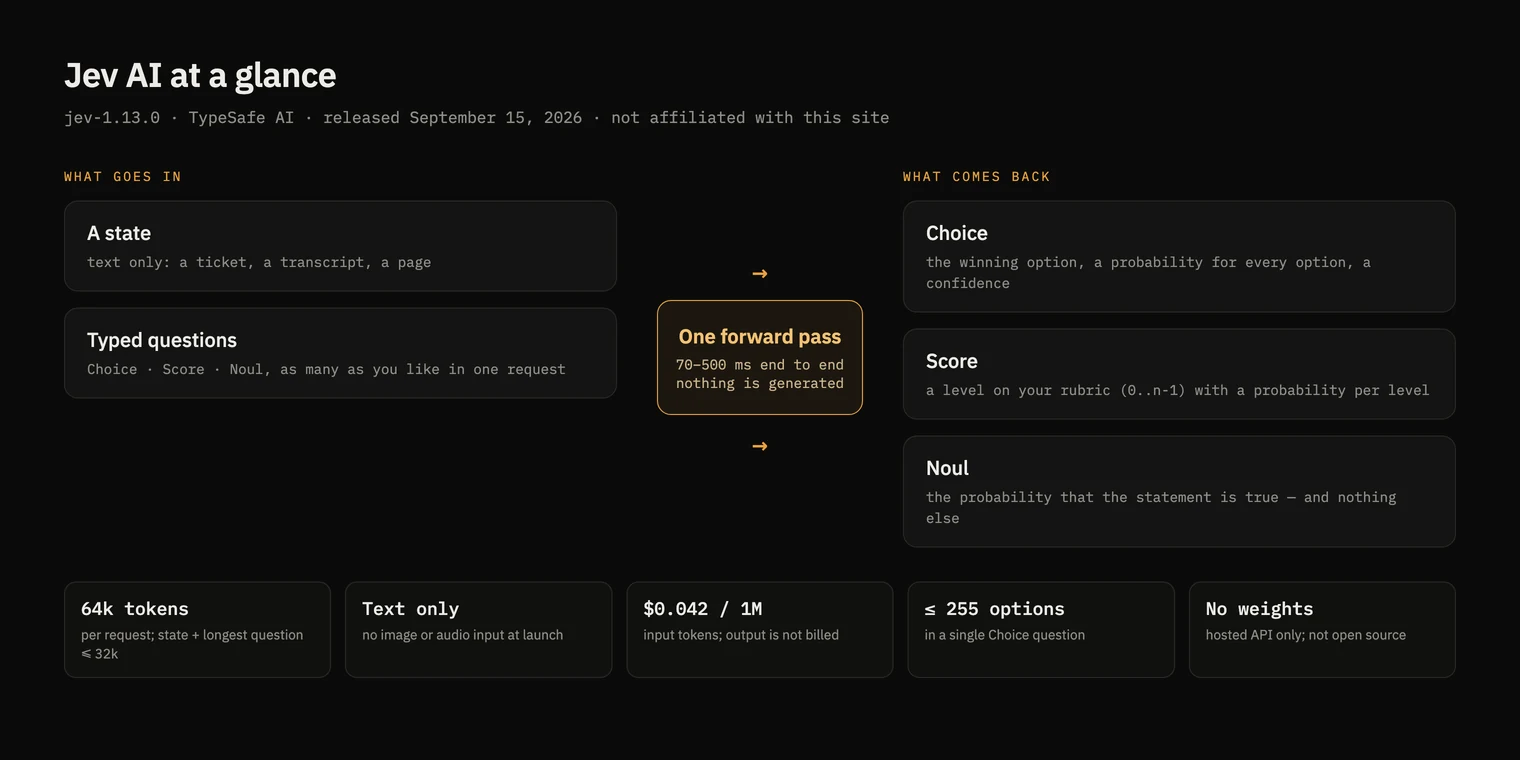
Jev AI is a decision model built by TypeSafe AI. It reads the text you send — a support ticket, a transcript, a web page — and answers typed questions about that text with probabilities, all in one forward pass. It never writes a sentence back. TypeSafe calls this kind of model a System One model, after the fast, intuitive half of human judgment.
| Made by | TypeSafe AI |
|---|---|
| Released | September 15, 2026 |
| Current model | jev-1.13.0 |
| Input | Text only |
| Context | 64k tokens per request |
| Price | $0.042 per 1M input tokens — output is not billed |
| Speed | 70–500ms end-to-end |
Is Jev AI an LLM?
Not in the sense people usually mean. An LLM such as GPT or Claude reads text and writes text. Jev AI reads text and returns numbers: which option wins, where a passage sits on a scale, or how likely a statement is to be true. Three question types cover everything the Jev AI model does:
- Choice picks one option from a list of up to 255 and returns the winner, a probability for every option and a confidence.
- Score places the text on an ordered rubric you define and returns the probability-weighted level, with a probability for each level.
- Noul answers a yes-or-no statement with the probability of yes, and nothing else.
Because nothing is generated, there is no output to bill and no prose to parse. Why a model class like this exists at all is on the System One page; the exact request and response shapes are in the API reference.
How does Jev AI work?
You send one request holding a state and as many questions as you like, and Jev AI answers all of them in the same pass — which is why a dozen questions take barely longer than one. The option and level descriptions you write are the whole prompt: rewording them moves the probabilities more than anything else you can change.
TypeSafe trains the model with RLCD, aiming for calibration: when Jev AI says 0.9, it should be right about nine times in ten. That is what makes the confidence usable — route the clear cases automatically and send the uncertain ones to a person or a bigger model. The same weights serve every customer; there is no per-account fine-tuning or LoRA.
Is Jev AI multimodal?
No. Jev AI takes text only; TypeSafe lists no image or audio input at launch. To decide about a screenshot or a call recording, turn it into text first — OCR, a caption from a vision model, or a transcript — and send that as the state. English is where accuracy is best. Other languages, Chinese and Japanese included, work, but TypeSafe says not equally well, so test Jev AI on your own data before relying on it in another language.
What is the Jev AI context window?
64k tokens per request, shared between the state and every question in it. A second limit is tighter: the state plus the single longest question must fit in 32k. OpenRouter lists typesafe/jev-1.13 with a 32K context, which matches that second figure.
Fitting is not the same as working well. TypeSafe's own failure-mode notes say accuracy falls as the state fills with text unrelated to the decision, so send Jev AI the part of a document the question is about, not the whole file. The other limits, and the cases where a different tool is the better pick, are on the limitations page.
Is Jev AI free?
No. TypeSafe documented no free tier or trial credit at launch. Input costs $0.042 per 1M input tokens, and output is not billed because there is none. On this site's benchmark fixtures a decision averages 447 input tokens, about $0.0000188 each — so a million Jev AI decisions cost roughly $18.77 at list price.
The price is the same through OpenRouter and the Vercel AI Gateway. Worked examples and a calculator are on the pricing page; this site sells its own access as one-time credit packs on the plans page.
Can you run Jev AI locally?
No. TypeSafe has released no weights, and Jev AI runs only on its hosted API; there is no self-hosted or VPC version. That also answers the other common question: Jev AI is not open source.
What you can run on your own hardware are open models trained for the same kind of one-pass decision: Plumb-4B (Apache-2.0), and the decider family fine-tuned from Qwen3.5, which serves the same /v1/systemone request shape. On JevBench v1.4.2.1 both scored above Jev 1.13.0 overall (65.8 and 64.1 against 63.3), while Jev kept the best calibration of the three. They are not Jev AI, but they are the honest answer to “Jev on Hugging Face”. The full list, with what each needs to run, is on the open source page.
Jev AI versions: jev-latest, jev-preview and jev-1.13.0
Jev AI shipped on September 15, 2026. The current weights are jev-1.13.0, and two aliases point at them: jev-latest, the newest official release and the SDK default, and jev-preview, the newest build of any kind. No preview build exists yet, so both resolve to the same weights today.
Aliases move when a release ships, so a confidence threshold tuned on today's weights can drift without a line of your code changing. Once you have tuned, request the versioned ID. Every response names the version that actually answered, which is worth logging next to each decision.
Who makes Jev AI?
TypeSafe AI, which came out of stealth with Jev on September 15, 2026, backed by a $40M seed round led by DCVC. Its co-founder is Diogo Almeida, former OpenAI researcher and RLHF co-inventor. The company sells one product, the Jev API; what it has published and how its claims hold up are on the TypeSafe AI page.
What is Jev AI used for?
Anything that ends in a bounded decision rather than a paragraph: routing a request to the right model or tool, triaging tickets, moderating content, reranking search results, checking an agent's output before it ships, scoring leads. The use cases show eight of these with measured output and cost.
Jev AI also does judgment work people search for directly. This site's essay grader and AI resume checker run on it: every rubric score, and the chance a recruiter interviews, is a probability from the model rather than text an LLM wrote.
How to use Jev AI today
- TypeSafe's own API at
https://api.typesafe.ai/v1/systemone, with thetypesafe-sdk(Python) and@typesafe-ai/sdk(JavaScript) packages. Keys come from an early-access waitlist and are issued in batches. - OpenRouter, as
typesafe/jev-1.13. It does not appear in OpenRouter's default model list, because its modality is text-to-decisions rather than chat; request it by ID. - The Vercel AI Gateway, as
typesafe-ai/jev, at the same price. - This site: an API key for an endpoint with the same request shape, and a remote MCP server at
https://jev-agent.com/api/mcpwith seven judgment tools for Claude, Cursor and other agents.
Setup for each route, step by step, is on getting started; the MCP tools are documented on the grading API page.
Jev AI alternatives
Three, depending on the job. A chat LLM when the decision needs reasoning across a long document, or an explanation beside it — Jev vs LLM has the measured trade-off. A fine-tuned classifier such as BERT when the labels never change and the volume is enormous — see Jev vs BERT. And the open models above when the data cannot leave your own servers.
Sources
- TypeSafe AI — official documentation
- TypeSafe AI — Introducing System One Models & Jev
- OpenRouter — Jev 1.13 pricing & providers
- TypeSafe AI — Models reference (versions, aliases, rate limits)
- TypeSafe AI — Jev 1.13 jaggedness (vendor-documented failure modes)
- TypeSafe AI — HTTP API reference
- JevBench v1.4.2.1