Tool · Essays
AI essay grader that shows its rubric
Paste an essay, pick the level and, if you have it, the assignment. The essay grader scores it on six criteria a teacher uses, turns them into an estimated grade, and gives the chance a teacher would mark it B or higher. Then ask follow-up questions about the draft.
0 words
Your report appears here
- · A letter grade and a score out of 100
- · Six rubric scores, each with its level
- · The chance a teacher gives it a B or higher
- · Length, sentence and repetition checks
- · Then ask follow-up questions, one judgment each
How the essay grader works
Every criterion is a five-level ladder written out in words, from the bottom rung to the top. The model reads the whole essay once and places it on each ladder, returning a probability for every level rather than a single guess, so a thesis can sit between “clear, specific” and “precise, arguable” and the report says which way it leans. The grade is the weighted position across all six.
| Criterion | Weight | Top level |
|---|---|---|
| Thesis and focus | 15% | Precise, arguable thesis sustained throughout |
| Evidence and support | 20% | Well-chosen, specific support for every point |
| Analysis and reasoning | 20% | Insightful analysis that deepens the argument |
| Organization | 15% | Seamless organization that builds the argument |
| Development | 15% | Fully developed with depth |
| Language and conventions | 15% | Precise, varied and virtually error-free |
The bottom rung is worth 50 and the top 100, so an essay at the middle level on everything lands at 75, a C. Letters follow the usual US bands: 93 and up is an A, 90 an A-, 87 a B+, and so on down to 60. One rule does not come from the model: an essay under 150 words is capped at a D+, because there is not enough of it to grade as complete.
Beside the grade sits a separate yes-or-no judgment: would a teacher grading this assignment at this level give the essay a B or higher? It is answered as a probability. When the letter and the probability disagree, look at the lowest criterion; that is usually where they part ways.
What we measured before launch
We wrote four essays on one assignment — should high schools start later in the morning? — each at a quality level we chose in advance, and graded them at high-school level on 26 September 2026.
| Essay | Words | Grade | B or higher |
|---|---|---|---|
| Strong: cites the AAP recommendation, answers the bus objection | 406 | A (94) | 83% |
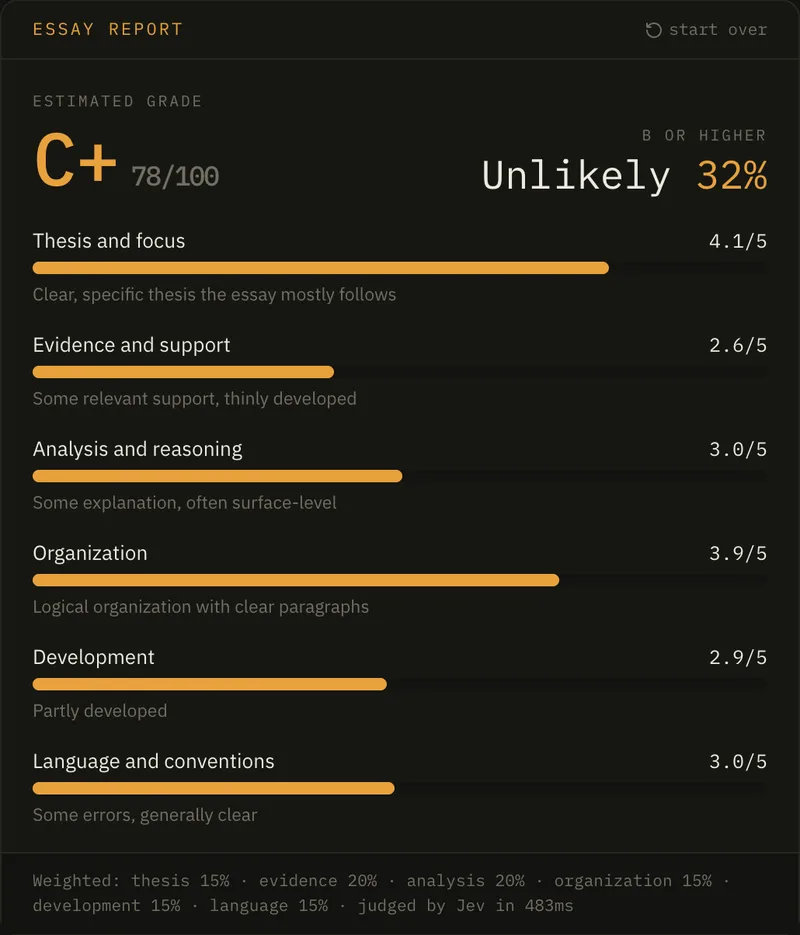
| Average: clear claim, thin support, spelling slips | 209 | C+ (78) | 31% |
| Padded: repeats the claim, no evidence at all | 333 | D+ (68) | 10% |
| Weak: 92 words, drifts off to the lunch line | 92 | D+ (67, capped) | 9% |
Length did not buy a grade. The padded essay is the second longest, yet its evidence score was the lowest of the four — 0.6 on a 0-to-4 ladder — because repeating a claim is not supporting it. The level setting matters too: graded as a college essay, the average one's chance of a B or higher fell from 31% to 19%. And the grades are stable: the average essay, graded three times, came back 78, 78 and 77.
Reading the report
Grade, criteria and the lean
Each criterion shows the level nearest to where the essay sits and a bar for its exact position, so “4.1 of 5” on analysis means just past “consistent explanation”, leaning towards “insightful”. The lowest bar is the one worth your next hour.
Counted, not judged
Under the grade are plain counts: words, paragraphs, sentences, average sentence length and the Flesch–Kincaid reading level. The checklist flags an essay that is short for most assignments, has fewer than three paragraphs, runs long or choppy sentences, or leans on one word too often. It ignores the assignment's own words, since an essay about school start times should say “school”.
Follow-up questions and comparisons
Under every report is a conversation. Ask a yes-or-no question — “Does every body paragraph support the thesis?” — and get a probability back. The grader judges; it does not write. A request such as “rewrite my conclusion” still produces a number from the model, and that number means nothing, so it is declined before it costs anything.
To improve a sentence, write two versions and use Compare. It asks which one a teacher would find stronger, then asks again with the order swapped and averages the two, because on close calls the model leans towards whichever option it read second. If the two orderings disagree, you are told it is too close to call.
How to raise the grade
- Evidence lowest: give every body paragraph one specific example, fact or quotation instead of a general claim.
- Analysis lowest: after each piece of evidence, add a sentence that says why it proves your point.
- Development lowest: cut to fewer points and explain each one further.
- Thesis lowest: make the claim something a reasonable person could disagree with.
- Language lowest: read the essay aloud; split any sentence you run out of breath on.
Then grade the new draft. Each run is a fresh reading, so the report tracks the revision rather than the first attempt.
What it is not
It is not a plagiarism checker or an AI-writing detector, and it does not verify facts, so a confident wrong statistic will not cost points here even though it would in class. It is also not your teacher. If you have the actual rubric, the AI grader scores against it directly.
Cost and privacy
Three runs need no account; a grade and a follow-up question each count as one. After that you sign in with Google, and your account gets a monthly allowance of credits, with one-time top-up packs that never expire. A 400-word essay plus the six questions comes to about 1,300 input tokens, so a grade costs 2 credits.
Questions
How accurate is the grade?
It is an estimate from a written rubric, not your teacher's mark. In our tests it put four essays of known quality in the right order on every criterion, and the same essay graded three times came back 78, 78 and 77. Your teacher's own rubric and priorities will differ, so read the criteria, not just the letter.
Does it work for middle school and college essays?
Yes. Pick the level before grading; the same essay is judged against what that level expects. Moving our average essay from high school to college lowered its chance of a B or higher from 31% to 19%.
Can it grade against my teacher's rubric?
Not on this page, which uses the six-criterion rubric shown above. The AI grader page takes any rubric you paste, one criterion per line, and scores on your point scale.
Does the essay grader check grammar and spelling?
It judges them as one criterion, language and conventions, and the checklist flags overused words and very long sentences. It does not mark individual errors line by line; a spell checker does that better.