Tool · Teachers
Rubric generator: write a rubric, then test it on real work
Describe the assignment and the rubric generator writes the rubric: criteria, levels, points and a description in every cell a grader can point to. Edit any cell, copy the table into a document, and before you grade a class with it, test the rubric on one essay to find the levels that are too close to call.
How the rubric generator works
You describe the assignment, the grade level, how many levels you want and the total points, plus anything the rubric must weight or ignore. A language model writes the rubric in about six seconds, following rules that push every description toward something observable: how many, which kind, where, or whether.
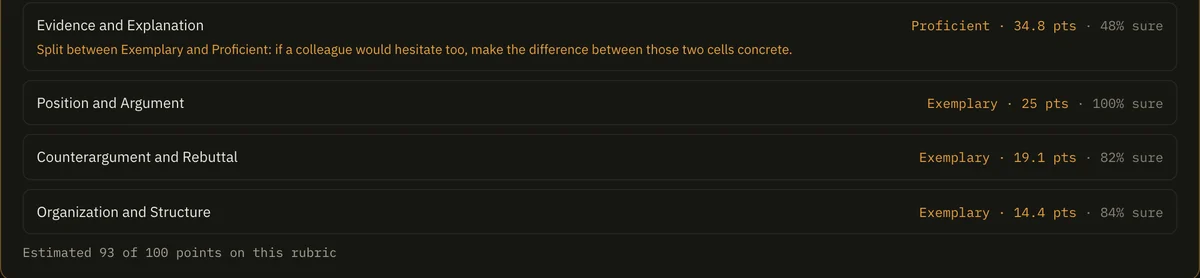
Then comes the part a chatbot cannot do. Paste one essay and Jev, a judgment model, places it on every row of the rubric and reports how sure it is. Where it splits its answer between two neighbouring levels, those two descriptions overlap, and a colleague grading beside you would probably split the same way.
Analytic, single-point or holistic
The rubric generator writes all three common kinds of rubric. Pick the one that fits what the grade is for:
| Rubric | What it looks like | Use it for |
|---|---|---|
| Analytic | A row per criterion, a column per level, a description in every cell | Graded work where students need to see which part earned the points |
| Single-point | One column saying what proficient looks like, space either side for notes | Drafts and feedback rounds, where comments matter more than points |
| Holistic | One scale for the whole piece, a paragraph per level | Timed writing and quick sorting, where one overall judgment is enough |
An analytic rubric is the default because it is the easiest to grade consistently and the easiest for students to act on. A single-point rubric only describes proficient work, which keeps it short and leaves room for comments about where a student fell short or went further. A holistic rubric gives one overall level for the whole piece.
What makes a rubric description gradeable
Most rubrics fail in the cells, not the criteria. “Good use of evidence” tells a grader nothing about where good ends and adequate begins. The rubric generator is told three rules for every cell:
- Observable. Name what the work does: “every body paragraph backs its claim with a cited study, statistic or expert”, not “excellent evidence”.
- Parallel. Each level of a row changes the same thing — how many, how well, how consistently — so a grader can tell neighbouring levels apart.
- One dimension per row. If counterarguments have their own row, the evidence row does not mention them, and no point is earned or lost twice.
Vague intensifiers such as effectively, thoroughly or adequate are allowed only when the cell also says what they look like in the work.
Example: a rubric for a 10th-grade argumentative essay
This is the rubric generator's real output on 2026-09-27, in 5.1 seconds, for the example assignment in the tool — a 600 to 900 word essay on later school start times, with evidence weighted highest and spelling ignored.
| Criterion | Exemplary | Proficient | Developing | Beginning |
|---|---|---|---|---|
| Evidence and Support40 pts | Every body paragraph backs its claim with cited evidence (studies, statistics, experts) and thoroughly explains how it proves the claim. | Most claims have cited evidence; one or two claims may rely on opinion or have less developed explanations of evidence. | Evidence appears once or twice but is not consistently cited or explained, or claims frequently rest on opinion. | No cited evidence; claims are based entirely on opinion or are unsupported. |
| Position and Argument25 pts | Clearly states a precise position and maintains a consistent, persuasive argument throughout the essay. | States a clear position and generally maintains a consistent argument, with minor deviations. | States a position, but the argument may be inconsistent or unclear in places. | Does not clearly state a position, or the argument is absent or contradictory. |
| Counterargument and Rebuttal20 pts | Addresses at least one relevant counterargument thoroughly and provides a strong, well-supported rebuttal. | Addresses at least one relevant counterargument and provides a reasonable rebuttal. | Addresses a counterargument but the rebuttal is weak, unclear, or missing. | Does not address any counterarguments. |
| Organization and Clarity15 pts | Essay is logically structured with clear paragraphs, transitions, and a compelling introduction and conclusion. | Essay is generally well-organized with clear paragraphs and transitions, and a clear introduction and conclusion. | Organization is sometimes unclear; paragraphs may lack focus or transitions, or introduction/conclusion are weak. | Essay lacks clear organization, making it difficult to follow the argument. |
We then tested the rubric on three essays written at known levels. They scored 80, 54, 36 out of 100, in that order. The strong essay was placed at Exemplary for its position and organization, and the test flagged two rows: on Evidence and Support it split between Proficient and Developing, and on Counterargument and Rebuttal between Exemplary and Proficient.
Test a rubric before you grade with it
The Evidence split is a real flaw. For a short essay, “most claims have cited evidence; one or two rest on opinion” and “evidence appears once or twice and is not explained” can describe the same paragraphs. The fix is a number: “three or more cited sources” against “one or two”. Experienced teachers catch this by grading two sample papers together before a class set; the test does the same with one essay, in under a second.
Use a sample you wrote at a known level, or a past student's essay with the name removed. If the rubric puts it where you would, and nothing is flagged as split, the rubric is ready.
From rubric to grades
Copy table pastes a formatted table into Google Docs or Word and plain columns into a spreadsheet. CSV downloads the same rows, and print opens a clean page with just the rubric.
To grade with it, open the AI grader from the button under the rubric: the criteria arrive filled in, you add up to thirty papers, and every paper gets points on every row. For a class set described in one sentence instead, the batch agent plans the rubric and grades in one thread.
Questions
What does the rubric generator cost?
Three rubrics without an account. After that each rubric comes from your credit balance at the language model's real cost, usually 60 to 110 credits, and testing it on an essay is one run of about 2 credits.
Can I edit the rubric before I use it?
Yes. Press edit and every criterion name and cell becomes a text box. The copy, CSV, print and grading buttons all use your edited version, so the rubric generator only ever gives you a first draft.
Can the rubric follow Common Core or my district's standards?
Put the standard's code or wording in the box for what the rubric must include, and the criteria are written against it. Check the result against the standard yourself before you share it with students.
Where does my assignment text go?
The assignment and your notes go to the language model that writes the rubric; an essay you test goes to Jev. Neither is stored on our servers, and your rubric stays in this browser tab until you close it.