What is a System One model?
A System One model answers typed questions about a state and never writes a sentence. The name borrows from Kahneman: System Two is slow, deliberate reasoning; System One is fast, automatic judgement. Today's LLMs are all System Two. Jev is the first model built to be the other half.
What is a System One model, in one paragraph?
It is a model that decides instead of writing. You send a state — a ticket, a transcript, a game position — with a set of typed questions, and every answer comes back as a value your code can branch on: the option it picked, a position on your rubric, or the chance a statement is true, with probabilities attached. Questions are answered in parallel against the same state, in one call.
| Input | a state plus typed questions — Choice, Score or Noul |
|---|---|
| Output | an option, a score or a probability — Choice and Score add a confidence |
| Output tokens | none — nothing is generated, so nothing is parsed |
| First one | Jev — TypeSafe AI, September 15, 2026 |
Quick answer · verified 2026-09-19
The gap it fills
An autoregressive LLM answers by writing. Even when the answer is one word from a list of four, the model composes a response token by token, and you get a string that you then have to coerce back into a type your program can use. Structured-output modes and JSON schemas make that less awful, but the underlying work is unchanged: generate text, then parse it.
That is a strange way to ask which of these four queues should this ticket go to. You pay generation latency and generation pricing for a decision that is, information-theoretically, two bits.
A System One model vs an LLM, on one ticket
We gave the same support ticket to Jev and to three chat models, 5 runs each, and asked how urgent it was on a four-level rubric. Gemini 2.5 Flash Lite answered 2 on every run and GPT-5 nano answered 3 on every run — two models, each made to name a single level, disagreeing with no sign that the call was close. Jev's Score came back between 2.63 and 2.68 every time: a probability-weighted position between High and Urgent, leaning Urgent. That lean is exactly what a rounded answer throws away.
The second difference is confidence. On 27 tickets with a clear right answer, Jev's confidence was 0.979; on 6 deliberately ambiguous ones it fell to 0.841. The chat models returned no confidence at all. A System One model is not more accurate for it — Jev and Mistral Small both got all 27 right — but it can tell your code when to stop trusting the answer. Method and tables are on benchmarks.
The trade Jev makes
What it gives up
- Free-form text generation
- Summarising, writing, coding, conversation
- Any answer outside the options you supply
What it gets back
- 70–500ms end-to-end
- Typed values with probability distributions
- No parsing, no retries, no schema drift
- Calibrated confidence on every answer
“It can’t hallucinate” — carefully
This claim gets repeated loosely, so it is worth stating precisely. Jev cannot invent an option that you did not give it, cannot produce malformed output, and cannot drift off schema — the output space is exactly the set you defined. In that structural sense, hallucination is impossible.
What a System One model is not
- Not a chat model with the text switched off. TypeSafe documents that forcing Jev to write by chaining choices works badly and slowly. One showcase experiment builds a chatbot anyway, one word per Choice, and mostly shows why you would not ship it.
- Not a calculator. Counting, arithmetic and comparing dates are documented weak spots; dates are read as text rather than as ordered quantities. Do the arithmetic in code and ask the model about the parts.
- Not a classifier you train. There are no labels to collect and no per-account fine-tuning; what you tune is the wording of the options. With plenty of labels for one fixed task, a fine-tuned classifier usually wins — see Jev vs BERT.
- Not a deep reasoner. Every hop of indirection costs accuracy. Several literal questions combined in code beat one big judgement: that is how a phishing study reached 95.1% with five signals where a single verdict had lost to Claude Haiku 4.5.
- Not an embedding model. An embedding is a vector to compare; this is a verdict over options you named.
Is Jev the only System One model?
It was the first to ship commercially, and it stays closed: no weights, no self-hosting, one hosted API. It is no longer alone. decider is a family of open System One models, 2B to 35B-A3B under Apache-2.0, answering Choice, Score and Noul in one forward pass on the same /v1/systemone endpoint. Plumb-4B is an open one-pass decision model whose every training round is published. And servers such as Lichen and OpenJev speak Jev's own API on open weights, so code written for Jev can be pointed at them.
Hosted rivals arrived from late September: OpenAI's GPT-6 Luna Decisions, Cloudflare's Clef, Perplexity's Decider V1.1, Upstage's Solar Decide and more, all on the same Decisions API. Each is described, with its limits and our measurements, on every decision model, one by one.
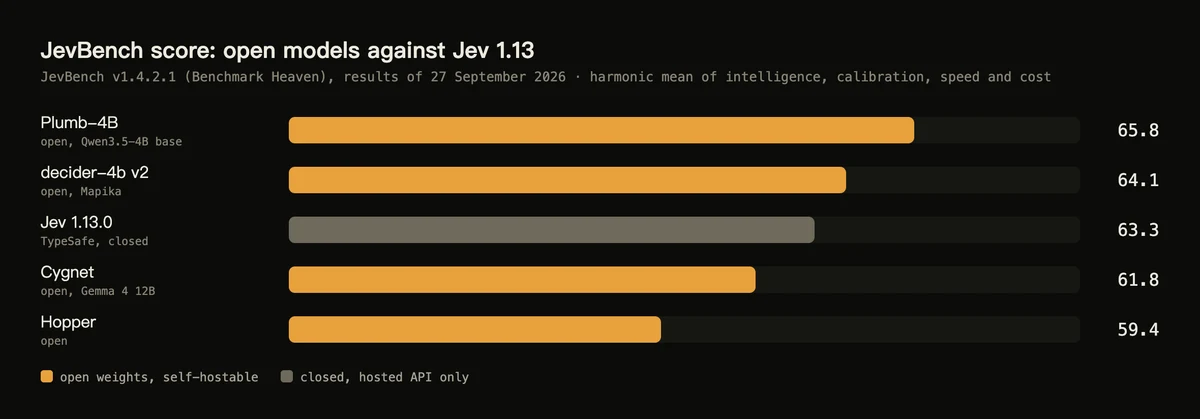
Read that ranking by its axes. The open pair gain most on speed and cost, which is what running your own hardware buys, while Jev keeps the best calibration of the top three at 76.3. The open-source page has the full table and what each one runs on.
How these models are trained
TypeSafe publishes one line on it — Jev is trained with RLCD for calibrated decisions — and no weights. The open projects show two routes. One reads typed option probabilities straight out of an existing model: SemIf does it with an open 4B model on a single 3090, and zhihz/openjev on a frozen Qwen3-4B-Instruct-2507. The other fine-tunes for the job: decider from Qwen3.5, Plumb-4B from JevK5 on teacher-written hard decisions. Getting the format right is the easy part; getting the probabilities honest is not — daseinlabs' open-jev, testing Gemma 3 4B zero-shot, found it over-confident on judgement calls.
Most systems want both
This is not a replacement for GPT, Claude or Gemini, and TypeSafe does not pitch it as one. The emerging pattern is a division of labour: Jev makes the fast decisions on the hot path — route this, classify that, is this good enough to send — and an LLM does the writing once a decision has been made. The jev-ultrafast browser agent is a clean example: Jev picks the operation and the element, and a small LLM is called only for the TYPE_TEXT operations that need words.
Who built it
TypeSafe AI came out of stealth on September 15, 2026 with a $40M seed round led by DCVC. Co-founder Diogo Almeida, former OpenAI researcher and RLHF co-inventor — which is part of why a new model class from an unknown company got taken seriously on day one rather than dismissed. More on the company page.
Common questions
Is a System One model an LLM?
Not in the usual sense. It takes text in but generates none: the answer space is exactly the options, rubric levels or yes/no you defined, returned with probabilities. Pipelines that use one still call an LLM for anything that has to be written.
Who makes System One models?
TypeSafe AI introduced the term with Jev on September 15, 2026. Open models built to the same contract now exist too, among them decider and Plumb-4B, and servers such as Lichen answer Jev's own API on open weights.
Can I run a System One model myself?
Not Jev, which is only available as TypeSafe's hosted API. The open ones, yes: the 4B models run on a single consumer GPU, and several servers expose them on the same /v1/systemone endpoint Jev uses.