Jev use cases: what a decision model is actually good for
Jev replaces the decision steps in your pipeline, not the writing. Each of these Jev use cases is a worked pattern with runnable code, the output the API actually returned, and honest caveats — plus independent evidence where it exists.
Use cases
What would you like to do with Jev?
- Where can I test a Jev agent router with my own routes?
Build a live routing decision · Inspect the routing policy
- Where can I try Jev online without writing code?
Open the live playground · Inspect the request and output
- How can I use Jev to choose the next tool for an AI agent?
Agent router playground: tool selection · See the other agent patterns
- How can I use Jev to route prompts between my own LLMs?
Agent router playground: model routing · Compare with TypeSafe's hosted router
- Where can I try TypeSafe AI's Jev Router and see which model it selects?
Open Jev Router on OpenRouter · Inspect the measured run
- How do I connect a hosted Jev MCP server to my agent?
Copy the MCP client configuration · Inspect the available judgment tools
- How can I test a Jev API request before integrating it?
Read the first API call · The same criteria in the playground
- Where can I find real Jev agent projects and code examples?
Browse the project directory · Explore the worked code examples
Support ticket triage
MixedAsk one Choice question for the queue and one Score question for severity in the same call — both come back in roughly the time one of them would take, for a fraction of a cent.
LLM model routing
ChoicePut a Choice question in front of your model cascade so a cheap fast model handles the easy majority and only genuinely hard requests reach a frontier model.
✓ Independent evidence
Agent tool selection
ChoiceLet Jev choose the tool and let an LLM fill in the arguments — the selection step stops scaling badly as your tool count grows.
✓ Independent evidence
Content moderation
MixedUse Score for severity tiers and Noul for specific policy checks, then act on the probability rather than a hard label.
Phishing and email security classification
MixedJev's single raw verdict lost on accuracy to a cheap LLM in an independent test — but combining five cheap signal questions from the same call beat it decisively.
✓ Independent evidence
RAG passage classification and reranking
ScoreScore each retrieved passage for actual relevance to the question and drop the ones that only matched on embedding similarity.
Agent output guardrails
NoulAsk several yes/no verification questions about a draft response in one parallel call, and block or regenerate when any probability crosses your line.
Lead scoring and qualification
MixedScore fit and intent against your own rubric, and route the hot ones to a human immediately rather than in tomorrow's batch.
Invoice classification
MixedRead the invoice text once and get three typed answers: the expense category, whether a person should check it before payment, and how soon it is due.
AI news filtering
MixedGive Jev a reader's interests and a headline, and get back whether to keep it, how relevant it is and what it is about, each with a probability.
AI product categorization
MixedOne listing in, every tag your catalogue needs out: category, main use, audience and yes-or-no attributes, each with a probability that says which tags to check.
CSV data validation
MixedLet code check formats and types, and ask Jev what code cannot answer, row by row: is this value plausible, does this email belong to this person, what is wrong here.
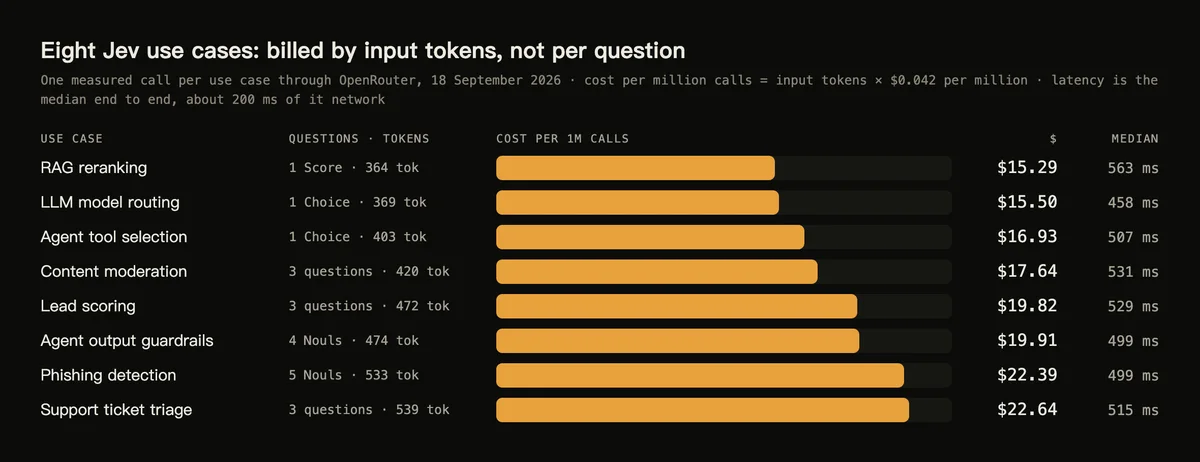
Twelve Jev use cases, measured side by side
Each row is the call printed on that page, made with the question definitions in its code sample and run against typesafe/jev-1.13 through openrouter.ai: the first eight on 2026-09-18, the last four on 2026-10-11. Some states are borderline on purpose, like a rude but not abusive post, so the probabilities have something to say. Latency is the median of three runs, network floor included (198.8 ms, then 260 ms); cost is input tokens at $0.042 per million, the only thing Jev bills.
| Use case | Primitive | Questions | Input tokens | Per call | Per 1M calls | Latency |
|---|---|---|---|---|---|---|
| Support ticket triage | Mixed | 3 | 539 | $0.0000226 | $22.64 | 515 ms |
| LLM model routing | Choice | 1 | 369 | $0.0000155 | $15.50 | 458 ms |
| Agent tool selection | Choice | 1 | 403 | $0.0000169 | $16.93 | 507 ms |
| Content moderation | Mixed | 3 | 420 | $0.0000176 | $17.64 | 531 ms |
| Phishing and email security classification | Mixed | 5 | 533 | $0.0000224 | $22.39 | 499 ms |
| RAG passage classification and reranking | Score | 1 | 364 | $0.0000153 | $15.29 | 563 ms |
| Agent output guardrails | Noul | 4 | 474 | $0.0000199 | $19.91 | 499 ms |
| Lead scoring and qualification | Mixed | 3 | 472 | $0.0000198 | $19.82 | 529 ms |
| Invoice classification | Mixed | 3 | 724 | $0.0000304 | $30.41 | 632 ms |
| AI news filtering | Mixed | 3 | 540 | $0.0000227 | $22.68 | 595 ms |
| AI product categorization | Mixed | 5 | 706 | $0.0000297 | $29.65 | 605 ms |
| CSV data validation | Mixed | 3 | 576 | $0.0000242 | $24.19 | 634 ms |
Question text is billed as input, so the five-word routing state still billed 369 tokens and the priciest pattern costs only about 2.0 times the cheapest. More questions barely move latency: phishing asks five and sits among the one-question patterns. Chat-model comparisons on each page come from a 2026-09-20 head-to-head, re-runnable from jev-measured; the full tables are on the benchmarks page.
Which Jev use case fits your pipeline
Sort the Jev use cases by where the decision happens in your system, not by industry.
- When something arrives. Support ticket triage, content moderation, phishing detection and lead scoring label a ticket, post, email or form with several judgements from one call.
- When records come in from outside. Invoice classification, product categorization and CSV data validation check records before they reach the ledger, catalogue or warehouse; an AI news filter does it per reader.
- Before a model call. LLM model routing decides how much model a prompt deserves before you pay for it.
- Inside an agent loop. Agent tool selection picks the next tool and leaves only the arguments to the LLM.
- Between retrieval and generation. RAG reranking scores each retrieved passage and keeps the ones that answer the question.
- Between generation and the user. Agent output guardrails check a draft before it is sent.
If your step is not listed, apply the test all twelve pass: can every acceptable answer be written down before the request? Then it is a Choice, Score or Noul question; if the answer is a sentence, use a generative model.
The pattern underneath all of them
Every use case here makes the same move: find the step where the answer is a decision rather than a sentence, stop paying a generative model for it, and, since extra questions cost almost nothing, ask the adjacent ones too. In the phishing benchmark, five cheap signal questions beat one big question. The other shared habit is the confidence gate: act alone when the answer is decisive, and pass the rest to a person, a bigger model or a review queue.
Where none of these Jev use cases fit
Besides writing nothing (see the questions below), Jev chooses only among options you send, so open-ended extraction has no clean way in. It reads text only through a hosted API with closed weights, and it is weakest at counting, arithmetic and dates, so several pages compute those in code first. The full list is on the limitations page.
Common questions about Jev use cases
What can Jev do?
Jev makes bounded judgments about text: classify a message, choose a handler or tool, score a candidate against a rubric, rank retrieved passages, or check a condition. Choice selects from your options, Score places the input on your ordered levels, and Noul returns a yes/no probability. Your application supplies the state and decides what happens after the answer.
Source · Checked 2026-10-04
What are practical examples of Jev use cases?
The twelve measured examples on this site cover invoice classification, news filtering, product categorization, CSV data validation, support-ticket triage, LLM model routing, agent tool selection, content moderation, phishing screening, RAG reranking, lead scoring and agent-output checks. Each pattern includes a real request and measured output. They demonstrate decision steps, not complete autonomous products or guaranteed performance on your data.
Method and evidence · Checked 2026-10-11
Can Jev write essays, code or chatbot replies?
The Jev decision model does not generate open-ended text. It can judge a draft, pick a tool or select a model, while a generative model writes the essay, code or reply. Jev Router can return chat text because the chat model it selects writes that response.
Method and evidence · Checked 2026-10-04
Can several Jev use cases share one call?
Yes, when they read the same state. Questions are answered in parallel against one state, so a support ticket can get triage and a moderation check in one call. An email and a retrieved passage are different states and need separate calls.
Can I use these patterns without writing the questions?
Yes. Eight of them are named rulesets on this site's classify endpoint: send the text and the ruleset id. The Jev request behind each ruleset is published in the API docs, so you can also take it to TypeSafe directly.