Tool · College applications
Common App essay grader for the 2026–27 personal statement
Choose the prompt you are answering and paste your draft. The grader scores what admissions readers look for — reflection, specific detail, voice and structure — checks the word limits the application enforces, flags stock phrases, and estimates the chance the essay stands out. Then ask follow-up questions.
0 words / 650
Your report appears here
- · A grade and a score out of 100
- · Reflection, detail, voice and structure, scored
- · The chance it stands out to an admissions reader
- · Word count against the 250–650 limit, stock phrases
- · Then ask follow-up questions, one judgment each
The personal statement in 2026–27
The seven prompts are the same as last year's, and the year before: Common App kept them unchanged for 2026–27, citing positive feedback from students, counselors and colleges (Common App announcement). You write one essay and every college on your list receives it. The form enforces a minimum of 250 words and a maximum of 650: a shorter draft will not submit, and the box will not take more than 650 words. The 2026–27 application opened on August 1, and last cycle the most chosen prompt was topic of your choice, at 28%, ahead of facing adversity at 23%.
The grader's prompt list summarizes each one in our words; read the exact wording on the Common App essay prompts page before you commit.
What the Common App essay grader scores
Six criteria, each a five-level ladder written in full. The model places the draft on every ladder and returns the probability of each level, so the report can say that your voice sits between “some personality shows” and “distinct”, and which way it leans.
| Criterion | Weight | Top level |
|---|---|---|
| Answers the prompt | 15% | Sharply focused answer to the prompt |
| Reflection and insight | 25% | Insightful reflection that reveals character |
| Specific detail | 20% | Vivid, specific scenes throughout |
| Voice | 20% | Unmistakably one person's voice |
| Structure and ending | 10% | Compelling arc with a resonant ending |
| Language and polish | 10% | Precise, varied and virtually error-free |
Reflection carries the most weight because it is the part only you can write: an essay about fixing a radio is about patience only if it says so, specifically. Grammar carries the least, not because it does not matter, but because a clean essay that could belong to anyone is the most common way a strong applicant disappears. Separately, the grader asks whether the essay would help you stand out to a reader at a selective college, and reports that as a probability.
Two drafts, one prompt
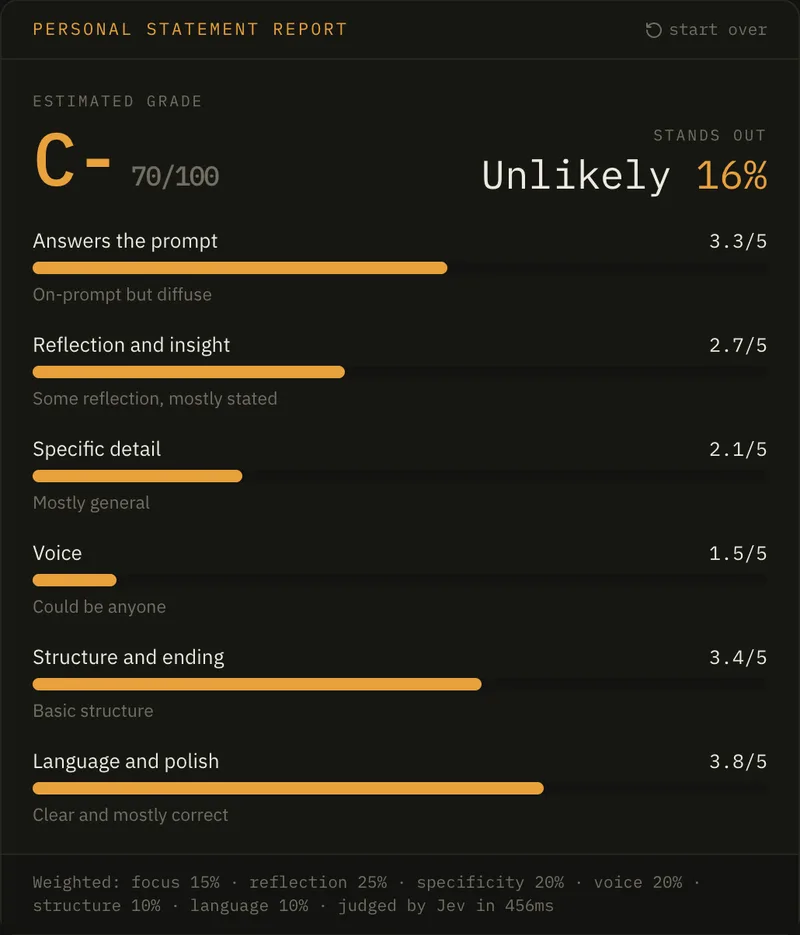
Before launch we wrote two personal statements for the personal-growth prompt and graded both on 26 September 2026. The first follows a summer spent repairing a radio with a grandfather who insisted on testing every part before guessing, and ends on how that habit now shapes a chemistry lab and a debate round. The second opens “Ever since I was a child, I have always been passionate about helping others” and lists activities.
| Draft | Grade | Reflection | Detail | Voice | Stands out |
|---|---|---|---|---|---|
| The radio (484 words) | A+ (99) | 4.0 | 4.0 | 3.6 | 79% |
| Helping others (337 words) | C- (70) | 1.7 | 1.1 | 0.5 | 16% |
Scores are positions on a 0-to-4 ladder. The generic draft is grammatically clean — its language score was 2.8 — and still graded C-, because voice (0.5) and detail (1.1) are where it could be anyone's. Prompt fit moved as it should, too: graded against the background-and-identity prompt instead, the radio essay's fit fell from 3.97 to 3.60 while everything else held.
Checks that need no model
Word count against the limits
The counter under the box turns red below 250 or above 650, and the report repeats what the form will do with each.
Stock phrases
The checklist looks for the phrases admissions readers meet thousands of times a season — “ever since I was a child”, “opened my eyes”, “make a difference in the world”, “out of my comfort zone” and two dozen more. The generic draft above had four. None of them is wrong; each is a place where the specific thing you mean would be stronger.
Revising with the report
- Reflection lowest: after the key scene, say what it changed in how you think — a habit, a belief — not a lesson any applicant could claim.
- Detail lowest: replace one summary sentence with one moment: a place, a time, something someone said.
- Voice lowest: read it aloud to someone who knows you and cut every sentence they would not believe you said.
- Structure lowest: let the ending answer the opening, so the essay closes rather than stops.
Use the follow-ups to test changes one at a time. Compare two opening lines and the grader asks which an admissions reader would find more compelling, in both orders, since on close calls the model favors whichever it read second.
What it cannot tell you
It is not an admissions prediction; colleges read the whole application, and one essay is a part of it. It cannot check that the story is true or yours. And its standard is a selective college's reader in general — a particular school's priorities may differ. For supplements, the essay grader with the question pasted as the assignment is the better fit.
Runs, credits and your draft
Grading a draft counts as one run, and so does each follow-up; the first three need no account. Signing in with Google gives you a monthly allowance, and credit packs are paid once and do not expire. A 500-word statement plus the grader's questions is about 1,300 input tokens, which is 2 credits.
Questions
How long should my Common App essay be?
Between 250 and 650 words; the application enforces both ends. Within that range, length is a choice: many counselors suggest using most of the 650 when the story needs the room, and the grader flags drafts under 400 so you can decide whether a second scene would help.
Which prompt should I choose?
The one your story already answers. The grader scores fit to whichever prompt you select, so you can grade the same draft against two prompts and compare. Topic of your choice was the most chosen prompt last cycle, at 28% of applicants.
Does the grader change my essay?
No. It reads the draft and returns scores and probabilities; it never writes or rewrites a sentence, so every word you submit is still yours.
Can it grade supplemental essays?
This rubric is built for the personal statement. Supplements answer a college's own question, so use the essay grader instead and paste the supplement's question as the assignment.