TypeSafe AI: the company behind Jev
Who they are, what they have raised, the one product they sell, and how to get a key. Written by an independent site from the company's own published material — with the gaps left as gaps.
Who is TypeSafe, in one paragraph?
TypeSafe AI is an AI lab whose bet is that decisions and text are different jobs. Its model, Jev, does not write: it takes a state and a set of typed questions and returns a chosen option, a score or a probability, each with a confidence — the “System One” to a chat model's “System Two”.
| Product | Jev — the first System One model |
|---|---|
| Out of stealth | September 15, 2026 |
| Funding | $40M seed round led by DCVC |
| Co-founder | Diogo Almeida, former OpenAI researcher and RLHF co-inventor |
| Pricing | $0.042 per 1M input tokens — nothing is generated, so there is no output to bill |
| Access | Closed API, console key dashboard |
Quick answer · verified 2026-09-19
The company
- Name
- TypeSafe AI
- Website
- typesafe.ai
- Announced
- September 15, 2026, alongside the Jev launch
- Funding
- $40M seed round led by DCVC
- Co-founder
- Diogo Almeida, former OpenAI researcher and RLHF co-inventor
- Product
- Jev — a closed, managed decision API
- Open weights
- None. No self-hosting or VPC option is offered.
- Customer data
- Not trained on customer requests or responses. Zero data retention is available to enterprise customers.
That is the whole of what the company has published about itself that can be checked. Headcount, location, other founders and revenue are not on its public pages, and this site does not fill the gaps from secondary sources — when they publish it, it will be here with a link.
The product: Jev
One endpoint, https://api.typesafe.ai/v1/systemone, and three question types — Choice, Score and Noul — plus, since Jev 1.14 on October 14, 2026, an experimental Box type for finding things in images. You send a state and any number of questions; every question is answered in the same forward pass, in 70–500ms end-to-end, and billed at $0.042 per 1M input tokens with nothing charged for output because no output tokens exist. The model is jev-1.14.0, requested as jev-latest, jev-preview, jev-1.14.0, jev-1.13.0.
What it is for, where it fails and what it costs at scale are each their own page: what a System One model is, limitations, Jev pricing and our own measurements.
How the company runs Jev
- Training
- RLCD, aimed at calibrated decisions. One set of weights serves every account — no per-customer fine-tuning or LoRA.
- Versions
- jev-1.14.0 today. jev-latest is the newest official release; jev-preview is the newest build of any kind, and both point at jev-1.14.0 for now.
- Request limits
- 64k tokens across the state and all questions, 32k for the state plus the single longest one, and at most 255 options in a Choice.
- Rate limits
- 100,000 tokens a second or 80 requests a second, adjusting without notice for now; crossing either returns a 429.
- Languages
- English first. Other languages, CJK scripts included, work but less well.
- SDKs
typesafe-sdkfor Python and@typesafe-ai/sdkfor JavaScript
The version line matters more than it looks. Aliases follow releases: when a new one ships, jev-latest points at new weights, and a confidence threshold tuned on the old ones can drift without any change on your side. Once you have tuned, send the versioned ID; every response names the version that answered.
What the company has published
- Documentation at docs.typesafe.ai: the HTTP API, both SDKs, and a models reference with versions, aliases and rate limits.
- A failure-mode page for jev-1.13, which TypeSafe calls jaggedness: literal reading, counting, dates, indirection, long irrelevant state, adversarial text and generation, each with a workaround.
- A cookbook of 20+ worked examples — legal analysis, RAG passage classification, entity alignment — plus an AutoResearch recipe for training a downstream classical model on Jev's probabilities.
- The launch post, whose two demos are games: a Doom bot at roughly 10 queries a second (about $7 an hour, and TypeSafe concedes a non-AI bot could play better), and Wikiracing, where Jev tended to finish in fewer steps than the LLM baselines.
- An agent skills package, installed with
npx skills add typesafe-ai/skills, that teaches an agent the Jev workflow.
TypeSafe AI's claims, checked
The headline is speed and cost: 193.6x faster and 444.6x cheaper than frontier LLMs in peak in-house testing. The company's own evaluation covers four workflows — security incident response, agent-trace observability, invoice processing and customer service — and scores each model against the averaged predictions of GPT-6 Astra and Anthropic Fable. Jev lands at 67.8%, level with GPT-5.6 Terra and below GPT-5.6 Sol and Opus 5. So the claim is comparable accuracy for far less, not better answers.
Checked independently, the direction holds and the size depends on the comparison. Across our eight fixtures a cheap chat model cost 1.4–1.7x what Jev did; on the support-ticket fixture, the frontier models from TypeSafe's own table cost 32.5–184.9x. On the independent JevBench (v1.4.2.1), Jev 1.13.0 scored 63.3 — third, behind two open models — while leading the top three on calibration at 76.3.
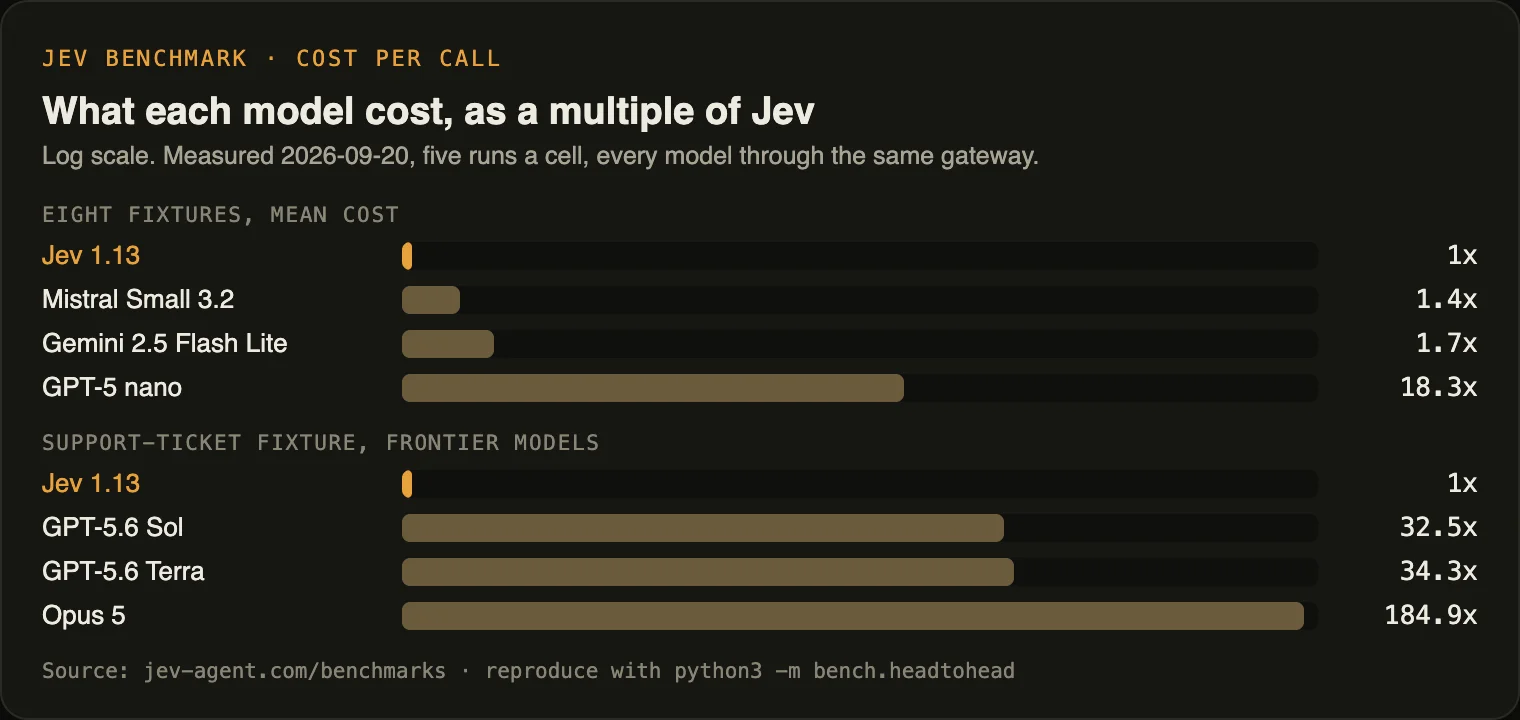
On price the company has been candid. It calls its pricing transparent, admits it cannot show the price is unsubsidised, and expects prices to fall rather than rise. No trial credit was documented at launch. The full tables are on the benchmarks page.
Getting access
Closed managed API. The current quick start directs users to the TypeSafe console playground and API-key dashboard. The current quick start links to the console key dashboard; no wait time is published. While waiting, the model is resold through OpenRouter and the Vercel AI Gateway (typesafe/jev-1.14 and typesafe-ai/jev-1.14.0), and this site issues keys against an endpoint that mirrors the official request shape. The full walkthrough is on getting started.
Frequently asked
What is TypeSafe AI?
TypeSafe AI is the company that builds Jev, the first of what it calls System One models — models that return a decision with a probability distribution instead of generating text. It came out of stealth on September 15, 2026 with a $40M seed round led by DCVC.
Who founded TypeSafe?
Co-founder Diogo Almeida, former OpenAI researcher and RLHF co-inventor. Other founders and the full team are not listed on the company's public pages at the time of writing, and this site does not guess.
What does TypeSafe sell?
One product: the Jev API, a closed managed service at POST https://api.typesafe.ai/v1/systemone. It takes a state and typed Choice, Score and Noul questions and returns every answer in one call, priced at $0.042 per 1M input tokens with no output tokens. There are no open weights and no self-hosted option.
How do I get access to TypeSafe's API?
Closed managed API. The current quick start directs users to the TypeSafe console playground and API-key dashboard. Until a key arrives, Jev is also resold through OpenRouter and the Vercel AI Gateway, and this site issues keys against the same request shape.
Can I download Jev's weights?
No. The company has released no weights, and Jev runs only on its hosted API. Open models built to answer the same questions exist, and on JevBench v1.4.2.1 two of them scored above Jev 1.13.0 — but they are not Jev.
Does TypeSafe train on customer data?
No, according to its documentation: Jev is not trained on customer requests or responses, and zero data retention is available to enterprise customers. The same weights serve every account; nothing is fine-tuned per customer.
Sources
- TypeSafe AI docs: current quick start (checked 2026-10-04)
- TypeSafe AI docs: Score primitive
- TypeSafe AI docs: confidence routing
- TypeSafe AI docs: example use cases
- TypeSafe AI docs: introduction
- TypeSafe AI blog: Introducing System One Models & Jev
- TypeSafe AI blog: Jev 1.14: images, Box and longer context (2026-10-14)
- TypeSafe AI docs: Images (experimental input, limits, token billing)
- TypeSafe AI docs: Box question type (Jev 1.14)
- TypeSafe AI docs: Models reference (versions, aliases, rate limits)
- TypeSafe AI docs: Jev 1.13 jaggedness (vendor-documented failure modes)
- TypeSafe AI docs: HTTP API reference