Tool · Resumes
AI resume checker with a recruiter's verdict
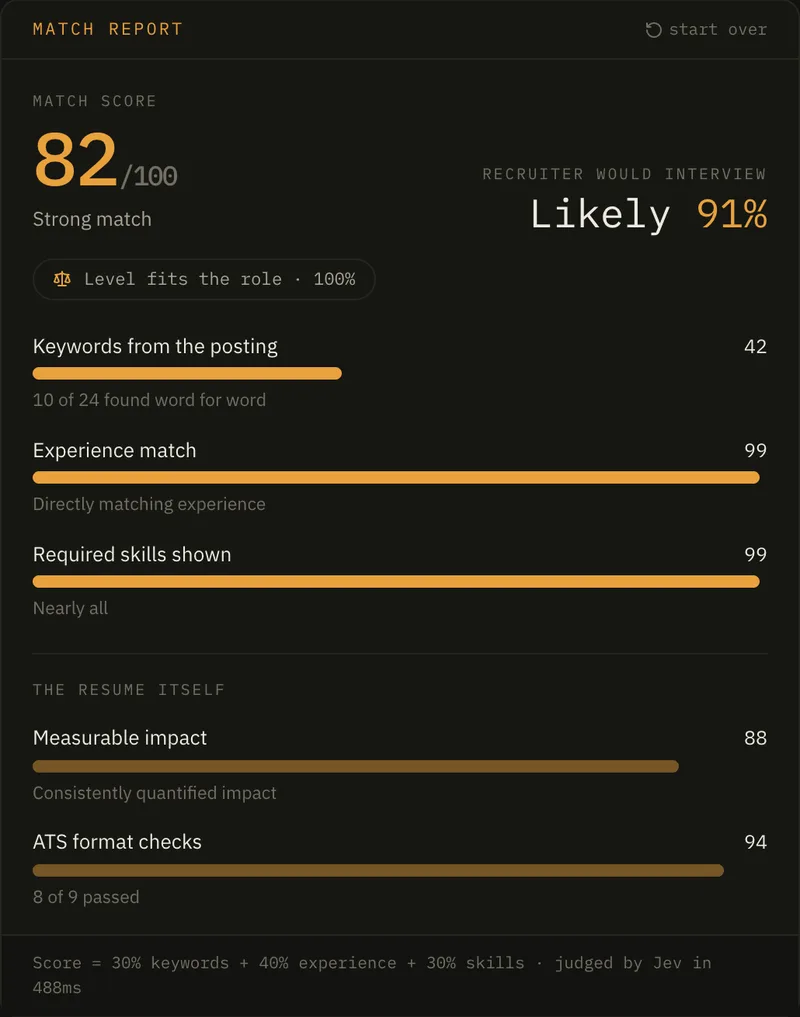
Paste your resume and the job description. The AI resume checker returns a match score out of 100, the posting's keywords your resume is missing, ATS format checks, and the probability that a recruiter moves you to interview. Then keep asking: every follow-up question gets its own judgment.
Your report appears here
- · A match score out of 100 for the posting
- · The chance a recruiter moves you to interview
- · Keywords from the posting your resume is missing
- · ATS format checks: contact details, headings, dates
- · Then ask follow-up questions, one judgment each
Applying in Japan? 日本語:履歴書 添削 AI checks a 志望動機 or 自己PR.
How the AI resume checker scores a resume
Most resume checkers either count keywords, which is what an applicant tracking system's search does, or ask a chat model for an opinion, which reads well and changes when you ask twice. This one does both jobs separately and tells you which number came from where.
Keywords, matched the way a search box matches
The checker pulls the terms a posting would be filtered on — tools, certifications, named methods and the short noun phrases in its requirements — and looks for each one in your resume, word for word. Requirements count double; the “About us” paragraph and the benefits list are skipped, because nobody screens on them. Matching is literal on purpose: a recruiter who types “SQL” into their ATS does not get back a resume that only says “PostgreSQL”. Plurals are folded and true abbreviations count, so “K8s” finds Kubernetes.
Five judgments a recruiter would make
The resume and the posting then go to Jev, a judgment model from TypeSafe AI that answers typed questions with calibrated probabilities instead of generating text. It answers five questions in one call: how closely your experience matches the core responsibilities, how many of the required skills you clearly demonstrate, whether your level fits the role, how well your bullets show measurable results, and whether a recruiter screening for this job would move you to interview. The first two use five-level rubrics, the level question is a three-way choice, and the last is a yes-or-no probability.
Format checks a parser needs
Last come plain rules that need no model: an email address and phone number in the body text, standard section headings (Experience, Education, Skills), dates on each role, a sensible length, achievement bullets and how many carry a number, and icon-font glyphs that some parsers turn into question marks. Upload a PDF and one more check runs: if the file has no text layer, you find out here, before an employer's system reads it as a blank page.
The match score is 30% keyword coverage, 40% experience match and 30% skills. Impact and format are shown beside it, not inside it: they describe the resume rather than the fit, and a well-written resume can still be wrong for the job.
We tested it before it shipped
A score is only useful if it moves when the fit moves. Before launch we ran a strong backend-engineering resume, and a deliberately vague version of the same resume, against three postings on 26 September 2026. Scores are on the 0–4 rubric; the last column is the probability of an interview.
| Resume and posting | Experience | Skills | Level | Interview |
|---|---|---|---|---|
| Strong resume, matching senior backend role | 3.75 | 3.85 | fits (1.00) | 0.90 |
| Same resume, content marketing manager | 0.00 | 0.00 | no clear answer | 0.02 |
| Same resume, staff platform engineer | 1.96 | 1.09 | too junior (1.00) | 0.11 |
| Vague version, matching senior role | 1.97 | 0.42 | too junior (0.92) | 0.23 |
The same resume went from a 90% chance of interview to 2% when the job changed, and to 11% for a role two levels above it. Rewriting the bullets vaguely — same jobs, no numbers — dropped the skills score from 3.85 to 0.42, because a skill you do not demonstrate is a skill the reader cannot see. The checker is judging the fit, not the formatting.
Ask Jagent follow-up questions
Under every report is a conversation. Ask any yes-or-no question about the resume — “Does my resume show experience leading a team?” — and you get a probability back, not a paragraph. In our tests, “Does this resume show leadership experience?” came back 0.93 for the strong resume, which mentions mentoring three engineers, and 0.21 for the vague one. Asked about PCI DSS experience, it said 0.10: the resume never mentions it, and the model did not pretend otherwise.
The agent judges; it does not write. Type “rewrite my summary” and the model will still return a number — 0.79 when we tried — and that number means nothing, so the checker declines instead of charging you for it. To improve a bullet, write two versions yourself and use Compare.
Compare two versions of a bullet
Compare asks which version a hiring manager for this job would find more compelling. It asks twice, with the order swapped, and averages the answers. That is not caution for its own sake. On a close pair, the version listed second won 0.90 to 0.10; with the order reversed, the other version edged it 0.53 to 0.47. Like most judges, human or model, Jev leans towards the last option it read when two are close. Asking both ways cancels the lean, and when the two orderings disagree you are told it is too close to call instead of being shown a winner.
How to act on the report
- Add missing keywords only where they are true. A term you cannot discuss in an interview costs more than it gains.
- Put the posting's exact job title in your headline or summary if it describes you; titles are the first thing recruiters search.
- Quantify the bullets that matter — scale, money, time saved, percentages. Aim for at least half of them.
- Use the standard headings. “Where I've been” is charming, and it leaves your jobs unfiled.
- Send a text-based PDF or a DOCX, and check the uploaded text here: if lines come out scrambled, a parser scrambles them too.
- Run the check again after editing. Each run is a fresh judgment of the new text.
What an applicant tracking system does with your resume
An ATS is the database a hiring team works from. When you apply, it parses your file into fields — contact details, jobs, dates, education, skills — and recruiters then search and filter that database by title, skill, years of experience and knockout questions such as work authorisation. None of that reads your resume the way a person does, which is why this resume checker keeps literal keyword matching and human-style judgment as separate numbers: the first decides whether a search finds you, the second whether the person who opens the file wants to talk to you.
Credits and privacy
Your first three runs need no account; a check and a follow-up each count as one. After that, sign in with Google: accounts get a monthly allowance of credits, and top-up packs are a one-time payment that never expires. A credit is 1,000 input tokens, so a typical check costs 2 credits and a follow-up question usually 1.
Questions
Does it work without a job description?
Yes. Leave the second box empty and the check scores the resume on its own — clarity, how specific the bullets are, measurable impact and format — and asks whether it is competitive for the kind of role it seems to target. Add a posting to get the match score and the keyword list.
How accurate is the match score?
It is a judgment, not a prediction of any one company's decision. Keyword coverage is exact; the experience and skills scores are the model's calibrated read of the text, and in our tests they moved the way they should. Treat 80 and above as a strong match, and anything under 40 as a sign the posting wants something the resume does not show.
Will it rewrite my resume for me?
No. It answers questions about your resume and compares versions you write. That keeps every answer a measurement you can act on, rather than new text you would have to check line by line.
Which files can I upload?
A PDF with a text layer, a DOCX or a plain-text file, up to 4 MB. For .doc or Pages files, export to PDF first. A scanned PDF is flagged, because an applicant tracking system reads it as a blank page.
Is an AI resume checker useful for ATS optimization?
For the parts an ATS controls — whether the file parses cleanly and whether a recruiter's keyword search finds you — yes; that is what the keyword list and the format checks cover. No checker can see one company's private filters, so the aim is a resume that parses and reads well everywhere.