Jev Connect Four, one Choice at a time
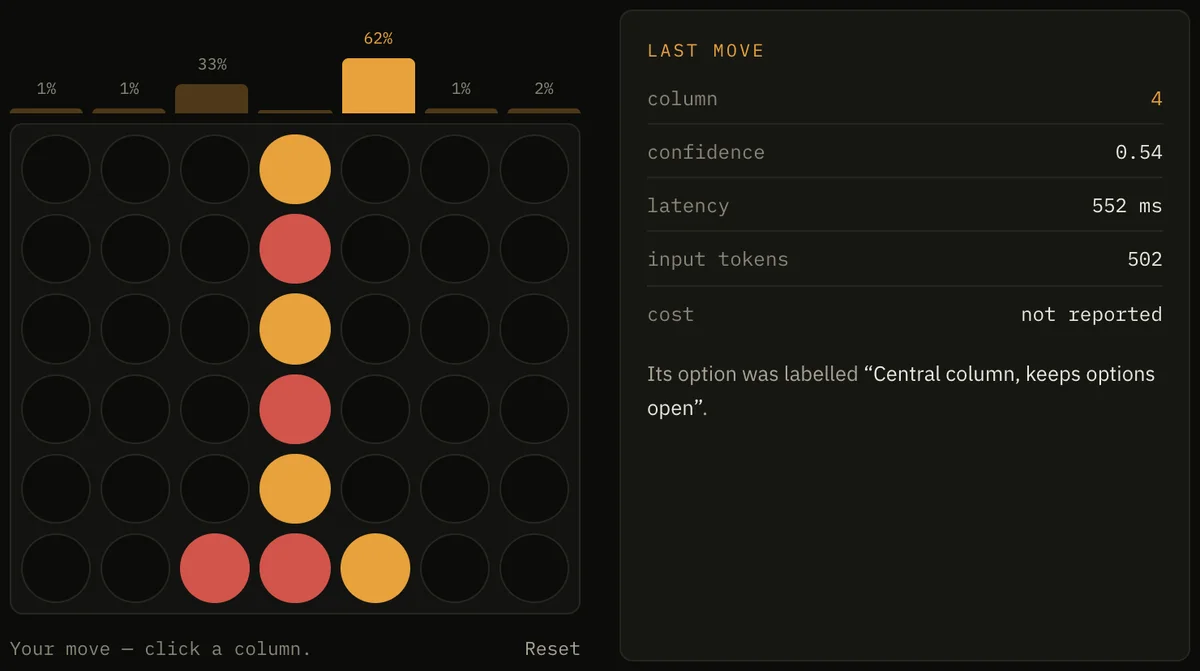
In Jev Connect Four you are red and Jev is amber. Every move it makes is a single Choice over the legal columns, and the bars above the board are the probabilities it returned — not a visualisation of something else.
Live demo
Last move
Drop a disc and Jev answers with a single Choice over the legal columns. Its probability for each one is drawn above the board.
How a Jev Connect Four move is made
Code owns the rules. lib/connect4.ts computes which columns are legal, drops the disc and scans for four in a row. Jev is told the rules in a few short lines but never applies them, and it cannot make an illegal move. All it does is pick one of at most seven options:
- Your disc lands in the browser, which checks for a win or a full board and, if the game goes on, sends all 42 cells to this site's server.
- The server checks the board is exactly 42 cells of empty, R or Y, refuses a finished game, and lists the legal columns — any whose top cell is still empty.
- Each legal column gets a one-line label, computed by code (below).
- Jev answers one Choice question — which column should Y drop into now — and the server drops its disc and scans for four in a row.
If the named column is missing or illegal, the legal column with the highest probability is played. Only if no probability is usable does a fallback take the winning column, else the blocking one, else the one nearest the centre — which is what the labels say anyway, so the fallback cannot contradict them. Every reply is a call on this site's account, which is why one visitor gets 30 moves a minute and all visitors together 2,000 a day.
The five labels Jev chooses between
Each option carries a short label, and that is deliberate: it is the single biggest lever. Option descriptions are the entire prompt surface, and seven bare digits would give the model nothing to reason over. The labels are computed by us, so this measures the model's choice between described options, not its ability to read a board.
- Wins immediately — a disc here completes four in a row for Jev.
- Blocks their win here — your disc here would complete four in a row.
- Lets them win directly above — Jev's disc would hand you the square on top of it, and the win with it.
- Central column, keeps options open — one of the middle three, columns 2 to 4.
- Edge column, fewer lines through it — everything else.
A column gets exactly one label, the first that applies in that order. A column that blocks your win but also gives you the square above is labelled only as a block, and anything that takes two moves to see — a double threat, a trap set for later — is never labelled at all. The labels look one move ahead; everything past that is up to the model.
What Jev sees on each turn
The state is the rules — Jev is Y and you are R (amber and red on screen), four in a row wins horizontally, vertically or diagonally, and discs fall to the lowest empty square — followed by the board as plain text. After your first disc in the middle column, the board part reads:
0 1 2 3 4 5 6
. . . . . . .
. . . . . . .
. . . . . . .
. . . . . . .
. . . . . . .
. . . R . . .
Column numbers sit on top, with row 0 at the top, because the answer Jev gives back is a column number and the two should look the same. The options use those numbers as keys, with each label as the description. There is no move history anywhere in the request: every reply is decided from the position as it stands.
Reading the bars and the panel
- The bars are scaled so the favourite is always full height; the percentage above each one is the actual probability. The column Jev chose is drawn solid.
- The panel lists the column, Jev's confidence, how long the model call took by the server's clock, the input tokens, and the cost the upstream route reported — “not reported” when it gave none.
- The label line under it quotes the label of the column that was played, with a note when the answer was unusable and the fallback chose it.
What Jev Connect Four does and does not show
Watch the confidence rather than the wins. It sits high when a column obviously wins or blocks, and collapses into a flat spread when the position needs looking ahead — which is the documented weak spot, and the thing worth seeing.
On our own measurements Jev is not reliably better than a one-line bot at games like this: across the 8 TextArena games we scored, it was measurably better than “always play the first legal move” at 2, worse at 1, and indistinguishable at 5. This is a demo of a Choice call with a live probability distribution, not evidence that Jev plays well.
The two setups also sit at opposite ends. Here every option arrives with a computed label; in the game benchmark each move was only its own label, close to the worst case for this model. A good Jev Connect Four game shows the labels doing their job; it does not show Jev finding the threat itself.
Jev Connect Four FAQ
Can Jev make an illegal move in Connect Four?
No. Only legal columns are offered, and the server checks the answer against them before dropping the disc. If the answer names no legal column, the most probable legal column is played instead.
Who moves first?
You do, as red. Each of your moves sends the whole board to the server once, and Jev answers in amber.
Why are there sometimes fewer than seven bars?
A full column is not a legal move, so it is never an option and gets no probability.
Does Jev see the board or only the labels?
Both: the state carries the rules and a text drawing of the board, and the options carry the labels. The labels carry the most weight: option descriptions are a Choice question's prompt surface, and no other edit shifts the probabilities as much.
What does the confidence number mean?
It is Jev's own confidence in the column it picked, returned with every Choice alongside the probabilities and shown to two decimals. It is not the chance of winning the game.
How much does a Jev Connect Four move cost?
A move is billed by its input tokens, at the published $0.042 per million, and nothing for output. The panel beside the board prints both the token count and the cost the route reported.